

ORIGINALLY PUBLISHED IN “CAPITAL”
When companies such as Mercedes-Benz and ABB, international sports federations and leading hospitals design their spaces, they do not compromise. For them, the indoor environment is critical infrastructure.
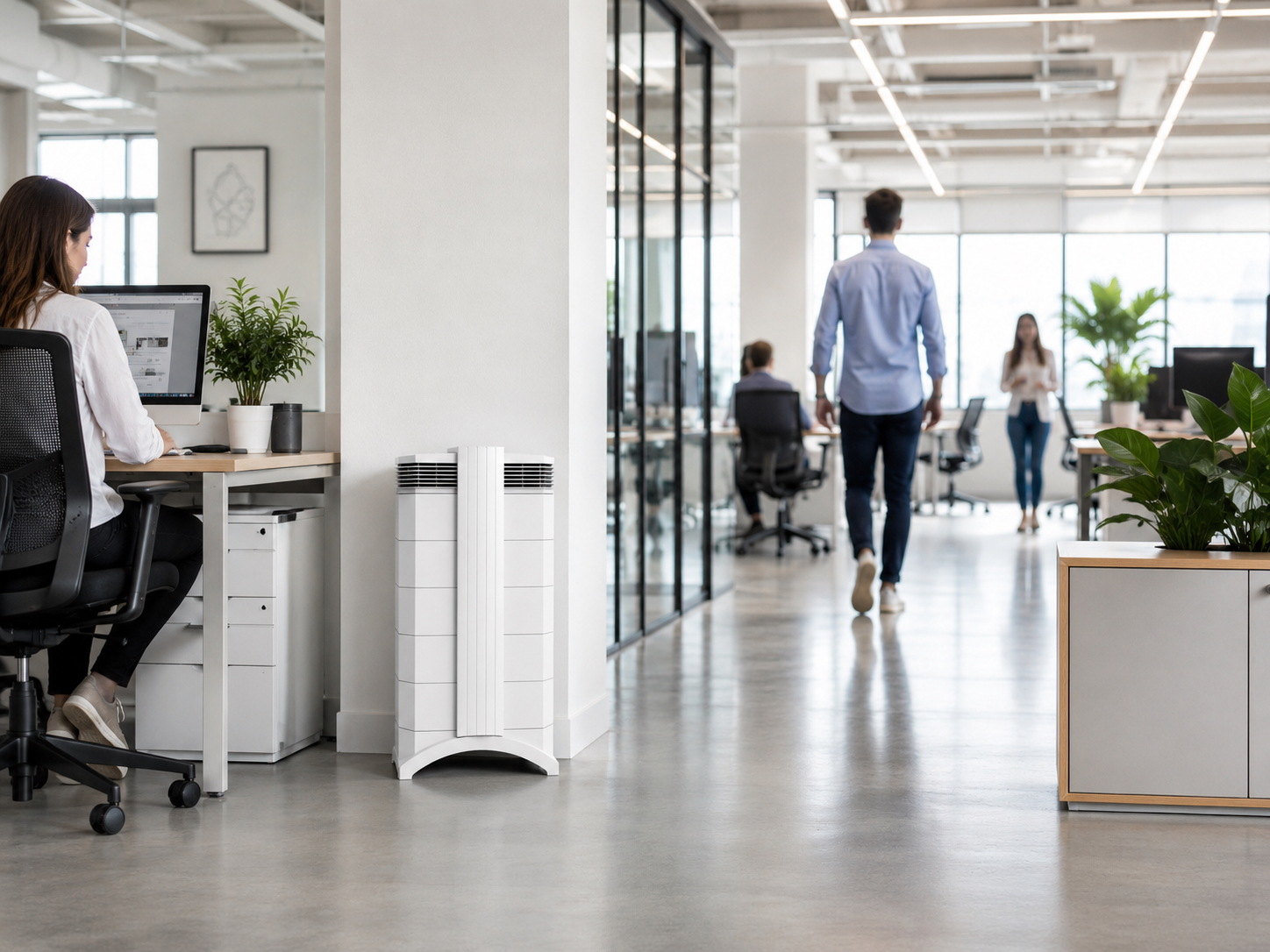
In Bulgaria, however, many managers still operate under a dangerous illusion. Against the backdrop of a severe labour shortage—where finding and retaining high-quality talent has become one of the most expensive battles in the market—businesses continue to make a major tactical mistake. The truth is blunt: if you rely solely on standard ventilation and opening windows, you are already losing money without even realising it. For months, you may have been paying 100% of salaries to employees whose capacity has been cut in half by headaches, stale air and cognitive decline. You have been paying the price of so-called “heroic” sick leave and undermining your brand image in stuffy premium spaces. If nothing changes, the losses will only become more expensive, because in a talent-scarce market people simply move to places where they do not leave work with a migraine at 5 p.m.
This is where AirCare Bulgaria comes in. We are not retailers that simply sell boxes with filters. AirCare is an engineering and technology partner that takes full control of the indoor environment: we enter your premises, measure with digital precision what your business is actually breathing, analyse critical points and deploy mobile systems from Swiss market leader IQAir to stop operational leakage and secure peak performance.
The real problem: not what is missing, but what remains in the office
In modern buildings, ventilation systems generally manage carbon dioxide (CO₂) levels reasonably well. Yet when the air feels heavy in meeting rooms at the end of the day, people instinctively open the windows for “freshness”.
That action brings fine particulate matter (PM2.5), dense urban smog, nitrogen dioxide from traffic and seasonal allergens indoors. Conventional HVAC systems capture only coarse mechanical dust. They are largely ineffective against microscopic pollutants, ultrafine particles, viruses and bacteria.
As a result, even when ventilation indicators look acceptable on paper, employees may still be breathing a hazardous cocktail of pollutants. The key risk-management question is no longer whether air is moving, but what remains suspended in it—and how it affects the team’s focus and health.
The direct cost: the three-dimensional productivity trap
A global analytical report by Deloitte and the Clean Air Fund (CAF) highlights a stark economic reality: lost working days and reduced employee efficiency caused by polluted air cost businesses billions every year. The study clearly shows that clean indoor air is not merely a “wellness expense” for comfort; it is a high-return investment that restores lost working capacity.
Without control over the indoor environment, every company enters a three-dimensional trap that drains the corporate budget through what may be described as operational friction:
·Traditional sick leave: Direct financial losses for the employer, combined with operational disruption caused by interrupted processes, delayed projects and additional pressure on the remaining team.
• Presenteeism: Employees who come to work while ill out of a misplaced sense of duty. They operate at minimal capacity, lose concentration, make costly mistakes and turn the office into an incubator by spreading pathogens through shared air circulation from desk to desk.
• Decline in overall productivity—or better human output: Even healthy employees lose focus under the impact of fine particles. The result is invisible cognitive fatigue, headaches and slower reaction times. The business pays full salaries for capacity that is artificially constrained by a poor indoor environment.
Professionally purified air cuts across all three risks by capturing pathogens at the point of release and helping people remain sharper and more focused.
The reputational factor in premium spaces
There are sectors in which the quality of the environment is directly tied to trust, customer experience and brand image. In bank branches, pharmacies, private clinics, premium service centres and representative offices, small details shape the perception of status.
The air in these premium spaces may appear fresh because it is constantly circulating, yet a common and misguided practice is to mask its actual quality with heavy artificial fragrances. Discerning clients and partners quickly recognise the difference between perfumed chemicals and a genuinely clean indoor environment.
Clean air has a direct neuromarketing effect on consumer behaviour: it can reduce perceived stress, anxiety and cognitive fatigue. When clients feel physically comfortable and protected, they spend more time in the space, consider details with less strain and make informed purchasing or partnership decisions more easily. Purified air becomes an invisible calling card for safety and prestige—demonstrating genuine care for both clients and frontline staff.
The Swiss benchmark: why IQAir technology stands apart
When the goal is uncompromising quality with no margin for error, the choice of technology is decisive. In professional air filtration, Swiss company IQAir holds the position of a global technology leader. For more than six decades, the brand has focused exclusively on developing purified-environment systems, becoming a recognised standard for medical, laboratory and high-technology applications.
Unlike mass-market products, IQAir purifiers carry the legacy of decades of German and Swiss engineering. The story began in 1963, when brothers Manfred and Klaus Hammes developed the world’s first residential air filtration system with a personal mission: to alleviate Manfred’s severe asthma. Their success helped create an entirely new industry. The company has remained independently family-owned, allowing it to invest in science rather than low-cost mass production.
Today, the brand is distinguished by several fundamental technological advantages:
· Revolutionary HyperHEPA filtration: While standard filters on the market are typically tested at 0.3 microns, IQAir technology is certified to capture ultrafine particles down to 0.003 microns with an efficiency of more than 99.5%. This provides protection against some of the smallest known viruses, bacteria and hazardous chemical agents.
· Individual quality testing: IQAir does not rely on statistical sampling. Every unit is individually tested at its facilities in Switzerland and Germany. A device leaves the production line only after meeting the required performance standards and is delivered with an individually signed certificate of actual performance.
· Zero ozone, maximum safety: IQAir strongly opposes ionisation technologies that generate ozone, a potent respiratory irritant. The company relies exclusively on safe, high-performance mechanical filtration of medical-grade quality.
Global trust in critical moments
The uncompromising nature of Swiss technology is one of the reasons IQAir has been selected by hospitals, research institutions and diplomatic missions around the world:
· In 2003, during the SARS epidemic, the Hong Kong Hospital Authority selected IQAir systems for hospital filtration to help reduce airborne transmission and protect medical staff.
· In 2008, the United States Olympic Committee relied on the company to purify the air in training facilities and athletes’ rooms in Beijing, helping mitigate the impact of severe urban smog.
· Global monitoring: IQAir is also the creator of AirVisual, one of the world’s largest free real-time air-quality platforms, processing data from tens of thousands of monitoring stations through advanced analytics and artificial intelligence.
Data-driven management: the brain of a clean environment
Intelligent cost optimisation begins with decisions based on measurable facts rather than broad marketing claims. Real-time monitoring of PM2.5, humidity, temperature and CO₂ is the brain of a clean indoor environment. Without data, HVAC systems operate blindly.
Smart purification automatically adapts to outdoor pollution and current room occupancy. This ensures maximum protection precisely when it is needed, while helping reduce unnecessary energy use and consumable costs.
Through detailed engineering analysis, precise measurement and expert solutions from Swiss market leader IQAir, AirCare helps businesses improve their indoor environments in a measurable way. Solutions are designed individually for the specific requirements of each space—from corporate offices and busy banking halls to pharmacies, medical centres and premium homes. Investment in clean air is no longer a luxury expense; it is a measurable standard for business resilience and high-quality working environments—premium air infrastructure.
AirCare Bulgaria — measurement, analysis and professional filtration for the air you breathe every day.
| Source note
This article was originally published in “Capital Health”. Any quotation or redistribution should credit the original source and include an active link to the publication on capital.bg. |
Get AQI data for Sofia and tips for clean air every Friday.
* By subscribing, you agree to our Privacy Policy .