

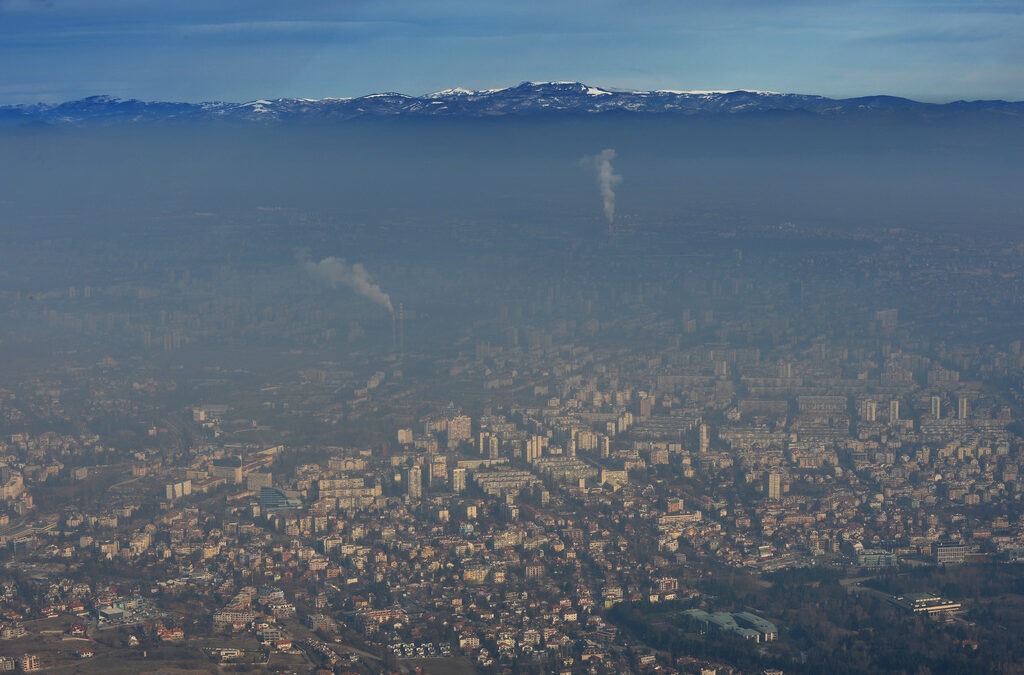
The air in Sofia isn’t an abstract problem. It’s a number you can measure — and a condition you can change.
What We’re Actually Breathing
Every morning, before you open your window, the air in Sofia already carries a story. Particles from residential heating, exhaust fumes from traffic, dust from construction and industry. All of this is measured in one number: PM2.5.
PM2.5 refers to fine particles with a diameter of less than 2.5 micrometers – about 30 times thinner than a human hair. They’re small enough to bypass your nose and lungs and enter your bloodstream directly.
The World Health Organization (WHO) recommends an annual average PM2.5 level of no more than 5 µg/m³. In Sofia, the annual average exceeds 20 µg/m³ – four times the recommended level.
When It’s Worst
Air pollution in Sofia isn’t constant. It follows a rhythm.
Morning, 6:00–9:00 AM. Temperature inversion traps polluted air close to the ground. Traffic wakes up. PM2.5 often reaches 40–60 µg/m³ – eight to twelve times above the WHO guideline.
Winter months, October–March. Residential heating with solid fuels adds enormous amounts of fine particles. On cold, windless days, levels can exceed 100 µg/m³.
Windless days. When there’s no air movement, pollution accumulates. Sofia’s valley acts as a trap.
What This Means for You
You breathe approximately 20,000 times per day. 80% of that time is spent indoors – at home, in the office, in your car. When you open a window in Sofia, you’re not “airing out” the room. You’re letting in the same air that’s outside – with all its particles. Ventilation systems in most buildings recirculate air. They move it, but they don’t clean it.
The result: indoor air is often more polluted than outdoor air.
The Health Consequences
Research links air pollution to:
– Worsening asthma and allergies
– Increased risk of respiratory infections
– Cardiovascular disease from long-term exposure
– Reduced cognitive function and concentration
– Disrupted sleep
Children, elderly people, and those with chronic conditions are most vulnerable. But the effects touch everyone — even when we don’t feel them directly.
What You Can Do
1. Measure.
You can’t manage what you don’t measure. Apps like IQAir AirVisual show air quality in real time – both outdoors and indoors (if you have a sensor).
Knowledge is the first step. When you see the number, decisions become easier.
2. Choose when to ventilate.
If you’re going to open a window, choose the hours with lower pollution — usually afternoon, when the sun has warmed the air and the inversion has dissipated.
3. Purify the air you breathe.
Medical-grade air purifiers filter particles that ventilation cannot remove.
Standard HEPA filters capture particles down to 0.3 µm. IQAir’s HyperHEPA technology filters down to 0.003 µm – one hundred times finer. This includes viruses, bacteria, ultrafine particles from exhaust, and allergens.
One purifier in your bedroom means 8 hours of sleep in clean air. Your body recovers. Allergic reactions decrease. You wake up differently.
Clean Air Isn’t a Luxury
Clean air isn’t a privilege for the wealthy or a concern for environmentalists. It’s a basic need – like clean water and quality food.
The difference is that air is invisible. You don’t see it until you measure it. You don’t feel it until you compare.
But once you feel it – when you wake up without a stuffy nose, when your child doesn’t cough at night, when you work for three hours without fatigue – you understand.
Air matters.
Get AQI data for Sofia and tips for clean air every Friday.
* By subscribing, you agree to our Privacy Policy .