

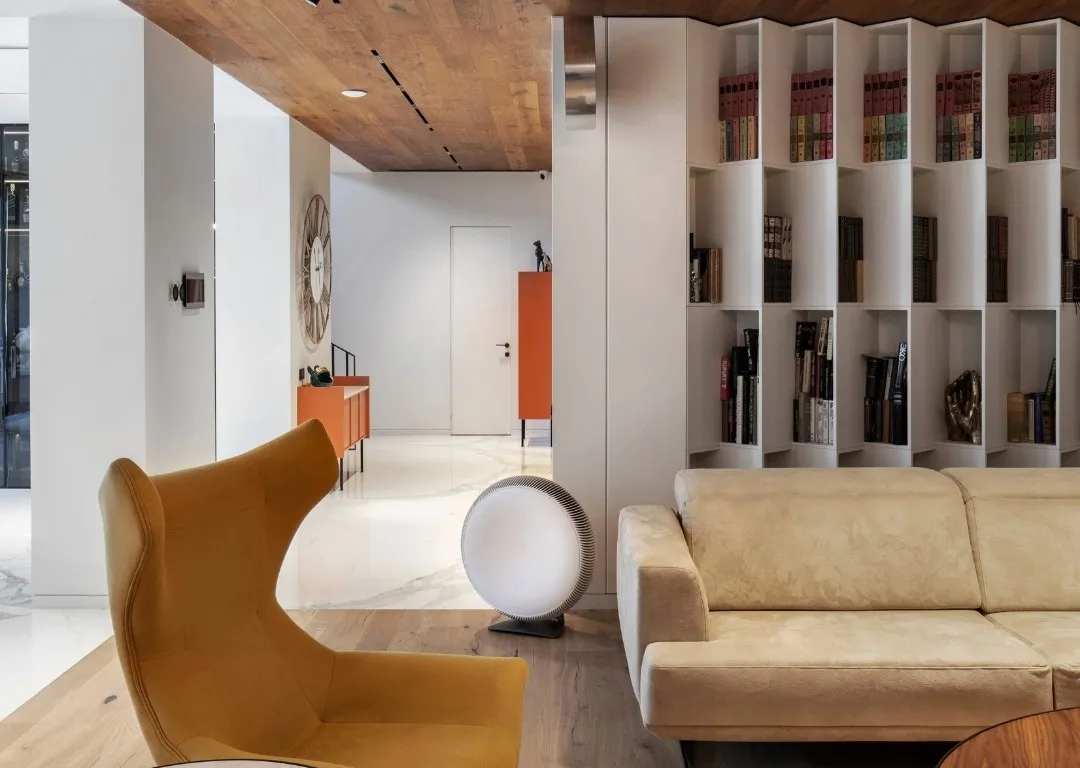
We monitor outdoor air quality. We check fine particulate matter levels, talk about traffic, pollution and smog. On days with poor air quality, we limit the time we spend outside and keep the windows closed.
But there is one paradox: we spend most of our lives indoors. According to data cited by both the European Commission and the U.S. Environmental Protection Agency, people spend approximately 90% of their time in enclosed spaces – at home, in the office, at school, in vehicles, shops, restaurants and public buildings. And yet, we know surprisingly little about the air we breathe in those spaces.
Indoor air is not simply outdoor air indoors
It is easy to assume that if a space looks clean, the air inside it is clean too. But these are not the same thing. Pollutants from the outdoor environment can enter a building through open windows, doors, ventilation systems and natural infiltration. At the same time, the building itself and the activities taking place inside it can create additional pollution.
Factors that influence indoor air quality include:
- fine particulate matter PM2.5 and PM10;
- volatile organic compounds (VOCs);
- building materials, furniture, textiles and flooring;
- cleaning and cosmetic products;
- cooking and other combustion processes;
- moisture and mould;
- people, pets and everyday activities;
- outdoor air pollution.
The U.S. EPA notes that concentrations of some indoor pollutants can be several times higher than outdoor concentrations. This makes indoor air quality much more than a question of whether a window is open or closed.
CO₂ matters. But it does not tell the whole story.
In recent years, more offices, schools and public spaces have started measuring carbon dioxide levels. That is a positive development. CO₂ can be a useful indicator of how effectively a room is ventilated, especially when many people are present. But low CO₂ levels do not automatically mean clean air. A room may be well ventilated and still contain fine particulate matter, volatile organic compounds or other pollutants. And the opposite is also true – intensive ventilation can reduce CO₂, but if outdoor air is heavily polluted at that moment, it can simultaneously bring particles inside. That is why a professional approach to indoor air quality cannot rely on a single value. It looks at the entire environment.
Invisible pollution
On 24 September 2026, Horizon Magazine of the European Commission brought this exact question into focus: what is actually present in the air inside our homes, schools and workplaces? The topic is now being investigated through several European research projects analysing indoor air composition, pollution sources and ways to reduce exposure. The reason is simple. Air is invisible. We can immediately see dust on a desk, a stain on a wall or a dirty floor. But we cannot visually determine the concentration of particles measuring 2.5 micrometres, nor can we see the presence of certain gaseous pollutants. That is why the perception of a “clean space” and the actual quality of its air can be two very different things.
Opening a window is not a strategy
Natural ventilation has an important role and is often the simplest way to reduce accumulated pollutants and CO₂. But its effectiveness depends on the surrounding environment. If a building is located near a busy road, construction site, industrial zone or in a city with high levels of fine particulate matter, outdoor air itself may become a source of indoor pollution. That is why managing indoor air requires a combination of different approaches. The EPA identifies three core strategies for improving indoor air quality: source control, adequate ventilation and air filtration/purification. There is no universal solution for every building. And this is exactly the difference between simply placing an air purifier in a room and managing air as a system.
Air is part of a building’s infrastructure
When we design an office, clinic, hotel, school or home, we think about lighting, acoustics, temperature, heating, furniture and interior design. Air quality should be part of the same conversation. Not as an additional product. But as part of the environment itself. This means first understanding what is happening in the specific space:
- What is its volume?
- How many people use it?
- What ventilation is already in place?
- What are the pollution sources?
- What do actual measurements show?
Only then should the appropriate solution be defined.
From “we have an air purifier” to “we know what air we have”
The next step in indoor air quality is not simply adding more devices. It is measurement, analysis, management and continuous control. Because the question should not be: “Do we have an air purifier?” It should be: “Do we know what people in this building are breathing?”
At AirCare, this is exactly how we approach air quality. We assess the specific environment, measure key parameters, analyse how spaces are used and develop solutions based on the actual needs of each location. Because if we spend approximately 90% of our lives indoors, the quality of the air in those spaces should not remain an invisible variable.
Get AQI data for Sofia and tips for clean air every Friday.
* By subscribing, you agree to our Privacy Policy .